
If you’ve ever installed a satellite dish for services such as Freesat, Sky, or free-to-air satellite television, you may have wondered how your dish can point in one direction and never need to move. The answer lies in the unique orbit used by communications satellites – the geostationary orbit.
These satellites appear to remain fixed in exactly the same position in the sky, allowing millions of homes to receive television, radio and internet services from a simple, fixed satellite dish.
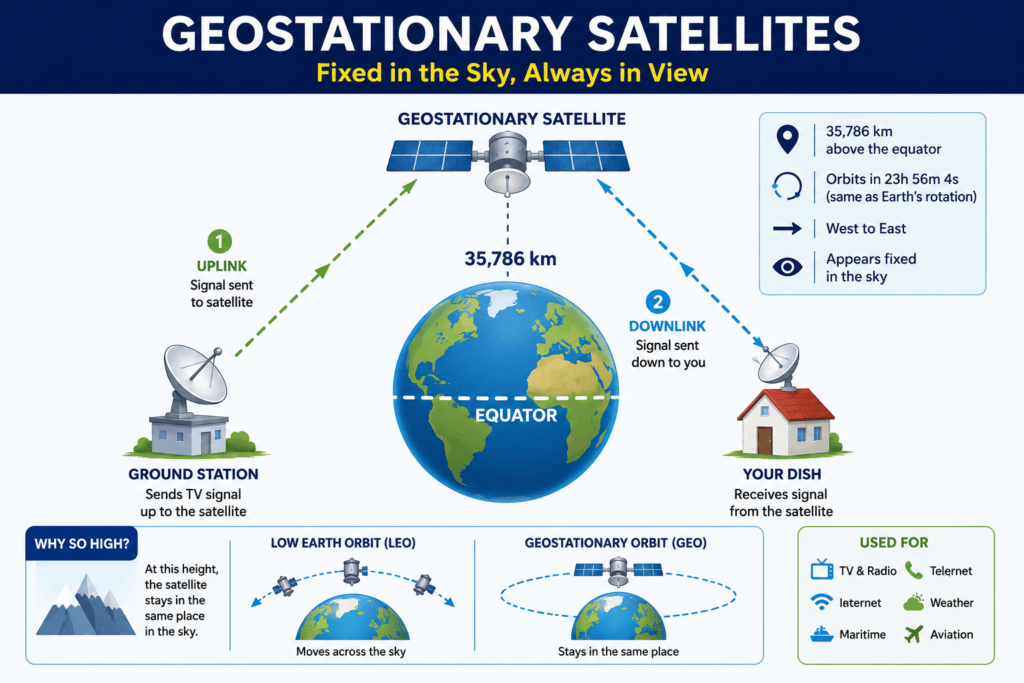
What does “geostationary” mean?
The word geostationary literally means “stationary relative to the Earth.”
Although these satellites are travelling at around 11,000 km/h (approximately 3 km/s), they orbit the Earth at exactly the same speed that the Earth rotates on its axis. This means they complete one orbit every 23 hours, 56 minutes and 4 seconds – one sidereal day. As a result, to someone standing on the ground, the satellite appears to stay in exactly the same place in the sky.
To achieve this, a satellite must orbit:
- Directly above the Earth’s equator.
- At an altitude of approximately 35,786 km (22,236 miles).
- In a perfectly circular orbit travelling from west to east.
This special orbit is known as the Geostationary Earth Orbit (GEO).
Why are geostationary satellites needed?
For television broadcasting, keeping a satellite fixed over one location offers enormous advantages.
A satellite dish only needs to be aligned once. After installation, it never has to track the satellite across the sky, making equipment simpler, cheaper and far more reliable.
Each communications satellite carries dozens of transponders, receiving signals from a ground station before amplifying and retransmitting them back to Earth over a wide coverage area. This allows a single satellite to deliver hundreds of television and radio channels to millions of homes simultaneously.
Without geostationary satellites, domestic satellite TV as we know it simply wouldn’t exist.
Why can’t satellites orbit lower?
A common question is why satellites aren’t placed much closer to Earth.
The answer is simple: a satellite in a lower orbit travels around the Earth much faster. It would constantly move across the sky from the viewpoint of someone on the ground, requiring every receiving dish to continually track its movement.
Low Earth Orbit (LEO) satellites, such as those used by Starlink, orbit only a few hundred kilometres above the Earth. They provide lower signal delay but require thousands of satellites moving continuously across the sky to maintain uninterrupted coverage.
By comparison, a single geostationary satellite can view roughly one-third of the Earth’s surface. Just three equally spaced satellites can provide communications coverage to most populated regions of the world.
Satellite TV and the Clarke Belt
Most television broadcasting satellites are positioned along the Clarke Belt, named after science-fiction writer and engineer Arthur C. Clarke, who first proposed the concept of global communications satellites in 1945.
Different operators position their satellites at specific longitudes above the equator. Examples include:
- 28.2° East – Astra satellites used for Sky and Freesat in the UK.
- 13° East – Hotbird satellites carrying hundreds of European channels.
- 19.2° East – Astra satellites serving Germany and much of mainland Europe.
These orbital positions explain why your satellite dish points towards a particular location in the southern sky (for viewers in Europe).
Are geostationary satellites only used for TV?
No. While satellite television is one of their best-known uses, geostationary satellites support a huge range of services, including:
- Television and radio broadcasting
- Satellite internet and broadband
- Telephone communications
- Military communications
- Maritime and aviation services
- Weather monitoring and forecasting
Weather satellites are particularly suited to geostationary orbit because they can continuously observe the same region of Earth, allowing meteorologists to monitor cloud movement and developing storms in real time.
A remarkable piece of engineering
Although they appear motionless, geostationary satellites are travelling at incredible speeds nearly 36,000 kilometres above the Earth. Their carefully calculated orbit allows them to remain fixed above one point on the equator for many years, making modern satellite television and global communications possible.
Every time you watch a programme on Freesat or Sky, your signal has travelled approximately 72,000 kilometres on its round trip between your satellite dish, the satellite in orbit, and the uplink station on Earth—all in a fraction of a second. It is an extraordinary achievement of science and engineering that most viewers never even think about.