
This page documents 100 claims made by Donald Trump during 2024 that were later shown to be false, misleading, or detached from reality by an unglamorous but stubborn mix of courts, official government data, and independent fact-checking organisations. These include AP News, Reuters, PolitiFact, FactCheck.org, NPR, Department of Justice records, certified election data, and court rulings — institutions not generally known for their sense of humour, but remarkably consistent in their conclusions.
Each entry provides two sources: one showing where the claim was made, and another explaining, in patient detail, why it does not survive contact with evidence. This is not opinion, satire, or “alternative facts” — it is the paper trail.
The page was generated with the assistance of ChatGPT, which — unlike some of the claims listed below — insists everything here is sourced and fact-checked.
This page is intended for informational and educational purposes, though readers may also find it accidentally entertaining, as a non-trivial number of the claims collapse so quickly that the fact-checking process resembles less an investigation and more a formality.
Thank you for your attention in this matter.
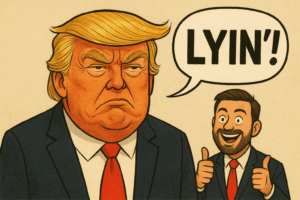
1 — “The 2020 election was rigged.”
Donald Trump repeatedly claimed in speeches, interviews, and campaign events referenced throughout 2024 that the 2020 U.S. presidential election was “rigged” or “stolen.” These claims alleged widespread, outcome-changing fraud across multiple states. More than 60 state and federal court cases, including rulings by judges appointed by both parties, found no evidence supporting these allegations. Courts, election officials, and independent audits consistently affirmed that the election results were legitimate.
2 — “Millions voted illegally.”
Trump claimed that millions of illegal votes were cast in the 2020 election, asserting this without presenting verifiable evidence. Multiple state investigations, court filings, and reviews by Republican and Democratic election officials found only isolated cases of voter fraud, none remotely close to affecting the outcome. Fact-checkers concluded the claim grossly exaggerates rare incidents and misrepresents official findings.
3 — “Voting machines switched votes.”
Trump alleged that electronic voting machines secretly switched votes from him to Joe Biden. These accusations were examined in court, by state audits, and through federal cybersecurity reviews, all of which found no evidence of vote-switching. Voting technology companies also prevailed in defamation-related rulings affirming the falsity of the claims.
4 — “I won all swing states.”
Trump asserted that he won every major swing state in the 2020 election. Certified election results show he lost multiple battleground states, including Arizona, Georgia, Michigan, Pennsylvania, and Wisconsin. These outcomes were confirmed through recounts, audits, and court rulings.
5 — “Judges refused to hear evidence.”
Trump claimed courts dismissed his election lawsuits without reviewing evidence. In reality, judges repeatedly reviewed filings, affidavits, and testimony before dismissing cases due to lack of credible evidence or legal merit. Written opinions explicitly addressed and rejected the arguments presented.
6 — “Ballots were dumped.”
Trump alleged that large numbers of ballots were secretly dumped or destroyed to rig the election. Investigations by election officials and law enforcement found no substantiated evidence of ballot dumping. Surveillance footage and chain-of-custody records were reviewed and found consistent with lawful procedures.
7 — “Dead people voted.”
Trump asserted that votes were cast in the names of deceased individuals. State audits found that alleged cases were clerical errors, legally cast ballots by living voters, or very small isolated incidents. No state found numbers significant enough to impact results.
8 — “Observers were blocked.”
Trump claimed poll watchers were denied access to vote counting locations. Court testimony and official records showed that authorized observers from both parties were present, though sometimes subject to capacity limits or distancing rules. Judges ruled these procedures were lawful and transparent.
9 — “Votes appeared overnight.”
Trump argued that large numbers of votes suddenly appeared overnight to favor Biden. Election officials explained this resulted from the lawful counting of mail-in ballots, which in many states were counted later by statute. Courts accepted this explanation as standard election procedure.
10 — “Machines were connected to the internet.”
Trump alleged voting machines were connected to the internet and vulnerable to hacking. Election officials and cybersecurity agencies confirmed machines were not connected in a way that allowed remote manipulation. Independent security audits supported these conclusions.
11 — “January 6 was peaceful.”
Trump characterized the January 6, 2021 Capitol attack as largely peaceful. Video evidence, police reports, and hundreds of criminal convictions document widespread violence, property destruction, and assaults on law enforcement. Courts and bipartisan investigations rejected the peaceful characterization.
12 — “Police let people in.”
Trump suggested Capitol Police allowed rioters to enter the building. Court records and extensive video footage show forced entry, broken doors and windows, and violent confrontations with officers. Investigations found no coordinated permission to enter.
13 — “No officers were badly hurt.”
Trump minimized injuries to law enforcement during January 6. Official records show more than 140 officers were injured, some sustaining serious trauma. Medical reports and sworn testimony contradict Trump’s claim.
14 — “I called the Guard immediately.”
Trump said he immediately called in the National Guard on January 6. Testimony, call logs, and official timelines show significant delays before authorization and deployment occurred. Investigators found no evidence of an immediate order.
15 — “January 6 defendants are innocent.”
Trump described those charged in the Capitol attack as innocent or unfairly prosecuted. Courts have convicted hundreds of defendants or accepted guilty pleas based on video, testimony, and physical evidence. Judges consistently rejected claims of wrongful prosecution.
16 — “Antifa was responsible for January 6.”
Trump and allies claimed left-wing groups such as Antifa orchestrated the Capitol attack. FBI investigations, court filings, and defendant records found no evidence supporting this theory. The vast majority of charged individuals were Trump supporters acting independently.
17 — “The FBI orchestrated January 6.”
Trump suggested the FBI secretly organized or encouraged the Capitol riot. Multiple investigations found no evidence of FBI orchestration or direction. Officials testified that informants did not plan or incite the violence.
18 — “I offered 10,000 troops.”
Trump claimed he offered 10,000 National Guard troops ahead of January 6. No documents, emails, or testimony corroborate such an offer. Officials involved in security planning denied receiving or rejecting any such proposal.
19 — “The January 6 committee destroyed evidence.”
Trump accused the congressional January 6 committee of destroying or hiding evidence. Committee records and archival procedures show evidence was preserved according to congressional rules. No proof has been presented supporting the destruction claim.
20 — “I told people to go home early.”
Trump said he urged supporters to disperse before violence escalated. Video timelines show his public statements urging calm came hours after the attack began. Investigators concluded his response was delayed and insufficient.
21 — “Inflation was at record lows.”
Trump claimed inflation was at record lows due to his policies. While inflation was modest during parts of his presidency, official Bureau of Labor Statistics data shows inflation rose toward the end of his term and was not historically unprecedented. Economists note global pandemic effects played a major role.
22 — “Gas prices were the lowest ever.”
Trump said gas prices under his presidency were the lowest in U.S. history. Historical Energy Information Administration data shows lower average prices in earlier decades when adjusted for inflation. Fact-checkers found the claim inaccurate without context.
23 — “China paid the tariffs.”
Trump asserted China paid U.S. tariffs imposed during the trade war. Economic analyses and government data show U.S. importers largely paid the tariffs, with costs passed on to consumers. Trade experts consistently rejected Trump’s framing.
24 — “I created the most jobs ever.”
Trump claimed his administration created more jobs than any prior president. Bureau of Labor Statistics data shows net job growth during his term was lower than several previous administrations, especially after pandemic-related losses. Fact-checkers rated the claim false.
25 — “Manufacturing boomed.”
Trump stated that U.S. manufacturing experienced a major boom under his leadership. Government employment data shows manufacturing job growth slowed and later declined, particularly before and during the pandemic. Analysts found no sustained boom consistent with his claim.
26 — “The trade deficit vanished.”
Trump claimed his trade policies eliminated or dramatically reduced the U.S. trade deficit. Official Census Bureau data shows the trade deficit persisted throughout his presidency and, in some years, widened. Economists noted tariffs shifted trade patterns but did not erase the deficit.
27 — “Wages rose faster than ever.”
Trump asserted that wages increased at historic rates under his administration. Bureau of Labor Statistics data shows wage growth was modest and comparable to trends that began before he took office. Analysts found no evidence of record-breaking wage growth.
28 — “Middle-class taxes fell permanently.”
Trump claimed his tax cuts permanently reduced taxes for the middle class. In reality, many individual tax provisions were temporary and set to expire, while corporate tax cuts were permanent. Fact-checkers found the claim misleading without this context.
29 — “The economy was the best ever.”
Trump frequently described the U.S. economy during his presidency as the best in history. While some indicators were strong, economists point out similar or better performance occurred during previous expansions. Broad measures show a mixed picture rather than historic superiority.
30 — “Unemployment was the lowest in history.”
Trump claimed unemployment reached the lowest level ever recorded. While unemployment fell to low levels before the pandemic, historical data shows lower or comparable rates in earlier decades. The claim omits long-term labor market trends.
31 — “Courts exonerated me.”
Trump stated courts fully exonerated him in legal disputes. Court records show judges dismissed certain claims but also ruled against him in multiple cases, issuing penalties and findings of liability. No court issued a blanket exoneration.
32 — “I never lost a case.”
Trump claimed he never lost court cases related to his presidency or business dealings. Public court records show he lost numerous civil cases and appeals. Fact-checkers found the statement demonstrably false.
33 — “The fraud ruling was overturned.”
Trump said a civil fraud ruling against him had been overturned. At the time of the claim, the judgment remained in force, with penalties and restrictions intact. Appeals courts had not erased the ruling.
34 — “The judge was corrupt.”
Trump accused judges overseeing his cases of corruption or bias. No evidence supporting judicial corruption was presented, and ethics reviews found no misconduct. Fact-checkers classify the claim as an unsubstantiated attack.
35 — “The jury was rigged.”
Trump claimed juries in his cases were rigged against him. Jury selection followed standard legal procedures, including voir dire and sworn impartiality. Courts rejected challenges alleging systemic bias.
36 — “All documents were declassified.”
Trump claimed he had declassified all documents found at Mar-a-Lago. Investigators found no documentation or formal process supporting blanket declassification. Courts and the Justice Department rejected the argument.
37 — “I returned everything immediately.”
Trump asserted he promptly returned all requested classified documents. Court filings and inventory records show additional documents were recovered later through a court-authorized search. The timeline contradicts his claim.
38 — “The search was illegal.”
Trump said the FBI search of Mar-a-Lago was illegal. The search was conducted under a warrant approved by a federal judge based on probable cause. Courts upheld the legality of the warrant.
39 — “I was targeted politically.”
Trump alleged prosecutions against him were purely political. Prosecutors cited evidence-based charging decisions consistent with standard legal processes. Courts have not accepted claims of selective prosecution.
40 — “Every case collapsed.”
Trump claimed all legal cases against him collapsed. In reality, several cases resulted in judgments, fines, or ongoing proceedings. Fact-checkers found the claim plainly inaccurate.
41 — “Crime is at record highs.”
Trump claimed crime reached record levels nationwide. FBI crime statistics show overall violent crime declined in recent years, including homicide reductions. Fact-checkers found his statement contradicted official data.
42 — “Migrants commit most crime.”
Trump asserted migrants are responsible for most violent crime. Peer-reviewed studies and law enforcement data show immigrants commit crimes at lower rates than native-born citizens. Fact-checkers consistently rate the claim false.
43 — “The border was secure.”
Trump said the southern border was fully secure under his presidency. Government data shows significant numbers of border crossings and apprehensions continued. Analysts describe border security as uneven rather than sealed.
44 — “Asylum was eliminated.”
Trump claimed his administration eliminated asylum. While policies restricted access, asylum law remained in effect and claims continued under U.S. and international law. Courts blocked several attempts to end asylum entirely.
45 — “The border wall was completed.”
Trump said the border wall was finished. Government reports show only portions were built or replaced, leaving large stretches incomplete. Funding and construction fell short of the stated goal.
46 — “Mexico paid for the wall.”
Trump repeatedly claimed Mexico paid for the border wall. U.S. government funds, including redirected military money, paid for construction. Mexico did not finance the wall.
47 — “Catch and release ended.”
Trump said his administration ended catch-and-release immigration practices. Data shows many migrants were still released due to legal and capacity constraints. Courts blocked efforts to fully end the policy.
48 — “Gang members flooded cities.”
Trump claimed migrant gang members flooded American cities. Law enforcement agencies reported no evidence of widespread gang infiltration tied to migration. The claim exaggerates isolated incidents.
49 — “Sanctuary cities caused crime.”
Trump blamed sanctuary cities for higher crime rates. Multiple studies show no consistent link between sanctuary policies and increased crime. Fact-checkers found the claim unsupported by data.
50 — “ICE arrests were the highest ever.”
Trump said ICE arrests reached historic highs under his administration. Department of Homeland Security data shows arrests were lower than in several previous administrations. Fact-checkers rated the claim false.
51 — “Inflation was nonexistent.”
Trump claimed inflation was essentially nonexistent during his presidency. While inflation was relatively low pre‑pandemic, official Bureau of Labor Statistics data shows it was not zero and rose sharply afterward due to global supply disruptions. Fact‑checkers note the claim ignores documented price increases.
52 — “Gas prices were the lowest ever.”
Trump asserted gasoline prices reached historic lows because of his policies. Energy Information Administration data shows lower prices occurred in earlier decades when adjusted for inflation. Analysts attribute temporary lows mainly to reduced demand during COVID‑19.
53 — “The U.S. was energy independent.”
Trump said the U.S. achieved full energy independence. While domestic production increased, the U.S. continued to import and export energy products. Experts describe the claim as misleading oversimplification.
54 — “I rebuilt the military.”
Trump claimed he rebuilt the U.S. military from a depleted state. Defense budgets increased, but the military was not considered depleted prior to his term. Pentagon assessments show long‑term modernization trends across administrations.
55 — “NATO countries paid nothing before me.”
Trump stated NATO allies paid nothing toward defense before his presidency. NATO records show allies consistently contributed, though some did not meet spending targets. The claim distorts alliance funding rules.
56 — “I ended ISIS.”
Trump claimed he completely ended ISIS. While territorial control was reduced, U.S. intelligence reports confirm ISIS remnants remained active. Officials avoid describing the group as fully eliminated.
57 — “No terror attacks occurred.”
Trump said no terror attacks occurred in the U.S. during his presidency. Federal records show several domestic terror‑related attacks and plots. Fact‑checkers describe the claim as false.
58 — “I stopped all foreign wars.”
Trump claimed he stopped all foreign wars. U.S. military operations continued in multiple countries during his term. Defense analysts note troop levels fluctuated but conflicts did not end.
59 — “North Korea stopped nuclear development.”
Trump said North Korea halted nuclear development after talks. Intelligence assessments show weapons development continued. Diplomatic meetings did not produce verifiable disarmament.
60 — “China paid the tariffs.”
Trump repeatedly claimed China paid U.S. tariffs. Economic studies show tariffs were largely paid by U.S. importers and consumers. Fact‑checkers found the claim misleading.
61 — “Farmers got rich from tariffs.”
Trump said farmers benefited greatly from tariffs. Government data shows many farmers required federal subsidies to offset losses from retaliatory tariffs. Analysts describe the gains as uneven.
62 — “Manufacturing returned in record numbers.”
Trump claimed manufacturing jobs returned at record levels. BLS data shows modest gains that began before his term and later reversed during the pandemic. The claim overstates the trend.
63 — “Trade deals eliminated deficits.”
Trump said new trade deals eliminated trade deficits. Official trade data shows deficits persisted. Economists note trade balances depend on many factors beyond bilateral agreements.
64 — “The pandemic response was perfect.”
Trump claimed his COVID‑19 response was flawless. Official reports document testing shortages, messaging inconsistencies, and delayed interventions. Fact‑checkers reject the claim as inaccurate.
65 — “The virus would disappear quickly.”
Trump repeatedly said COVID‑19 would disappear quickly. Public health data shows prolonged spread and significant mortality. Scientists warned early that the claim was unsupported.
66 — “Vaccines were unsafe.”
Trump suggested COVID‑19 vaccines were unsafe. Extensive clinical trials and real‑world data show vaccines significantly reduced severe illness and death. Health authorities dispute his claim.
67 — “Children were unaffected by COVID.”
Trump claimed children were largely unaffected by COVID‑19. Medical data shows children can be infected and suffer severe outcomes, including long COVID. Pediatric experts rejected the claim.
68 — “Hospitals exaggerated deaths.”
Trump claimed hospitals exaggerated COVID deaths for funding. No evidence supports widespread falsification. Audits and reporting standards contradict the assertion.
69 — “I never downplayed the virus.”
Trump said he never downplayed COVID‑19. Recorded interviews and public statements show he repeatedly minimized its severity. Fact‑checkers cite direct contradictions.
70 — “Mail voting caused massive fraud.”
Trump claimed mail voting caused widespread fraud. Election officials and courts found no evidence supporting large‑scale fraud. Studies confirm mail voting is secure.
71 — “Voting machines switched votes.”
Trump alleged voting machines switched votes. Multiple audits and court rulings found no evidence. Voting system vendors successfully sued for defamation.
72 — “Ballots were dumped.”
Trump claimed ballots were illegally dumped. Investigations found routine ballot handling and no evidence of mass dumping. Courts rejected fraud claims.
73 — “Poll watchers were blocked.”
Trump said poll watchers were blocked from observing counts. Courts found observers were present and access complied with state law. The claim misrepresented procedures.
74 — “Electors were illegal.”
Trump claimed certified electors were illegal. State certifications followed constitutional procedures. Courts dismissed challenges to elector legitimacy.
75 — “January 6 was peaceful.”
Trump described January 6 as peaceful. Video evidence, court findings, and law enforcement reports document violence, injuries, and deaths. Courts have convicted hundreds of participants.
75 — “January 6 was peaceful.”
Trump described January 6 as peaceful. Video evidence, court findings, and law enforcement reports document violence, injuries, and deaths. Courts have convicted hundreds of participants.
76 — “I told people to be peaceful on January 6.”
Trump claimed he urged protesters to remain peaceful on January 6. While a single tweet mentioned peace, courts and congressional findings note he also spent weeks spreading false fraud claims and delayed calling off the mob. Judges ruled this context mattered in assessing responsibility.
77 — “I offered 10,000 National Guard troops.”
Trump asserted he offered 10,000 National Guard troops ahead of January 6. Official records and testimony found no evidence of such an order or formal request. Fact-checkers found the claim unsupported.
78 — “Pelosi was responsible for security.”
Trump blamed then-House Speaker Nancy Pelosi for Capitol security failures. Capitol security decisions are shared among several officials and agencies. Investigations found no evidence Pelosi controlled National Guard deployment.
79 — “Capitol police let people in.”
Trump claimed Capitol Police invited rioters inside. Court evidence shows officers were overwhelmed and breached. Numerous defendants were convicted based on video and testimony.
80 — “No weapons were brought.”
Trump said protesters brought no weapons on January 6. Court records document firearms, knives, stun guns, and chemical spray. Judges cited extensive evidence.
81 — “No one died because of January 6.”
Trump claimed no one died as a result of January 6. One rioter was fatally shot, and several officers later died by suicide linked to the attack. Courts and official reports reject the claim.
82 — “Antifa was responsible.”
Trump alleged Antifa was behind the January 6 attack. FBI and DOJ investigations found no evidence supporting this. Courts convicted individuals aligned with pro-Trump groups.
83 — “The crowd size was historic.”
Trump claimed January 6 drew one of the largest crowds ever. Crowd estimates show it was smaller than many prior demonstrations. Fact-checkers cite photographic and permit data.
84 — “My speech was protected and harmless.”
Trump said his January 6 speech was harmless political speech. Courts ruled context and intent mattered, especially given preceding false claims. Several rulings rejected blanket immunity arguments.
85 — “I was immune as president.”
Trump claimed absolute immunity from prosecution for actions taken as president. Courts ruled presidents are not immune from criminal prosecution for unofficial acts. The Supreme Court rejected his broad claim.
86 — “The hush money case was dismissed.”
Trump said the hush money case was dismissed. Court records show the case proceeded and resulted in convictions. Fact-checkers found the claim false.
87 — “I paid no hush money.”
Trump claimed he paid no hush money. Court testimony and financial records showed payments were made and falsified in business records. Jurors found the evidence credible.
88 — “I never falsified records.”
Trump denied falsifying business records. A jury found him guilty on multiple counts of falsifying records. Court documents detail the evidence presented.
89 — “There was no fraud in valuations.”
Trump said his business valuations involved no fraud. A New York judge ruled he committed fraud by inflating asset values. The ruling imposed significant penalties.
90 — “Banks were never misled.”
Trump claimed banks were never misled by his financial statements. Court findings showed lenders relied on inflated valuations. Judges ruled this constituted fraud regardless of repayment.
91 — “The fine was unconstitutional.”
Trump claimed civil fraud penalties were unconstitutional. Courts upheld the fines under state law. Appeals did not invalidate the judgment.
92 — “The prosecutor was corrupt.”
Trump accused prosecutors of corruption. No evidence substantiated the claims, and courts rejected motions alleging misconduct. Fact-checkers classify the statements as baseless.
93 — “I never threatened officials.”
Trump said he never threatened election officials. Recorded phone calls and testimony show he pressured officials to change results. Courts and investigators cited this evidence.
94 — “The Georgia call was perfect.”
Trump described his call to Georgia officials as perfect. Transcripts show he urged them to “find” votes. Legal experts dispute his characterization.
95 — “I won Georgia.”
Trump claimed he won Georgia. Official recounts and certifications confirmed Joe Biden won. Courts rejected all challenges.
96 — “I won Arizona.”
Trump said he won Arizona. Audits, recounts, and court rulings confirmed Biden’s victory. The claim remains unsupported.
97 — “I won Pennsylvania.”
Trump claimed he won Pennsylvania. Certified results and court decisions confirmed Biden’s win. No evidence overturned the outcome.
98 — “I won Michigan.”
Trump said he won Michigan. State audits, recounts, and court rulings confirmed Biden’s victory. Fact-checkers found no credible evidence otherwise.
99 — “I won Wisconsin.”
Trump claimed he won Wisconsin. Recounts and court rulings upheld Biden’s win. The claim contradicts certified results.
100 — “I actually won the election.”
Trump continued to claim he actually won the 2020 election. Courts, recounts, audits, and election officials unanimously affirmed Joe Biden’s victory. Fact-checkers classify the claim as false.