
How Ted Turner Built CNN and Changed Television
There are very few people in television history who can genuinely claim to have changed the entire industry. Ted Turner is one of them.
Long before streaming services, before social media, and before modern rolling news became normal, Turner had a vision that many people thought was impossible. He believed television could operate 24 hours a day, reach the entire world through satellites, and build global audiences around dedicated channels instead of traditional broadcast schedules.
Today, that sounds completely normal. In the late 1970s and early 1980s, it sounded absurd.
Yet Turner’s ideas helped create modern television as we know it.
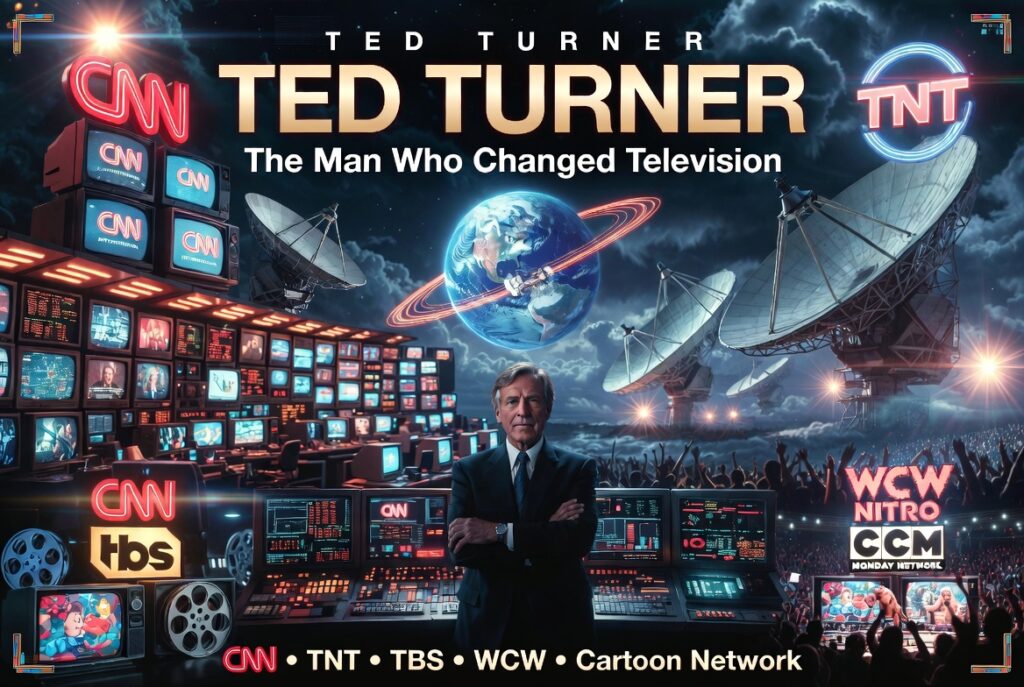
From the launch of CNN to the explosive wrestling battles between World Championship Wrestling and World Wrestling Entertainment, Turner’s influence spread across news, sport, movies, cartoons, and satellite broadcasting worldwide.
Even today, decades later, many television viewers still miss the identity and ambition of the old Turner broadcasting empire.
From Local TV Station to Media Empire
Ted Turner’s broadcasting journey began with a struggling UHF television station in Atlanta during the 1970s. Rather than thinking small, Turner embraced the rapidly growing satellite industry.
This decision would change television forever.
Using satellite distribution, Turner transformed his Atlanta station into a national “superstation,” eventually becoming TBS. Suddenly, local programming could be seen across the United States.
At the time, this was revolutionary.
Cable television was still developing, and most broadcasters focused only on local markets. Turner instead saw television as something global.
That ambition eventually led to one of the boldest launches in television history.
CNN and the Birth of 24-Hour News
When CNN launched in 1980, critics openly mocked the concept.
Many believed there simply was not enough news to fill an entire 24-hour television channel. Traditional broadcasters relied on scheduled bulletins shown a few times a day. Turner believed viewers would want constant access to live news coverage.
He was right.
CNN International would eventually become one of the most recognisable television brands on Earth. The channel changed not only how news was delivered, but also how major world events were experienced.
During events such as the Gulf War, CNN became essential viewing worldwide. For many viewers in Europe and across the satellite television boom of the 1990s, CNN International was one of the first major international channels available free-to-air.
For British and European satellite viewers especially, CNN became part of everyday television culture alongside channels from Sky and Astra satellite services.
Today, rolling news is completely normal. But CNN created the model that nearly every modern news channel still follows.
Turner Channels and the Golden Age of Satellite TV
For many viewers who grew up during the analogue and early digital satellite era, Turner channels were everywhere.
Channels such as:
- TNT
- Cartoon Network
- TCM
- CNN International
helped define multichannel television.
Cartoon Network became one of the biggest children’s channels in the world. TNT carried blockbuster films, sport, and wrestling. TCM preserved classic cinema for modern audiences. CNN delivered international news around the clock.
Unlike many modern television brands, Turner’s channels each had very distinct identities. They felt curated rather than algorithm-driven.
This was television built around channels people actively recognised and followed.
Ted Turner vs Rupert Murdoch
Another major part of television history was Turner’s rivalry with Rupert Murdoch.
Both men understood the future power of satellite and cable television before many others did. Both aggressively expanded internationally. Both built huge media empires around dedicated television channels.
But their visions were often very different.
Murdoch focused heavily on subscription television, sports rights, newspapers, and pay-TV dominance through companies like News Corporation and Sky.
Turner focused more on channel identity, global reach, live news, movies, and entertainment.
Throughout the 1980s and 1990s, the competition between Turner and Murdoch helped shape modern global television. Their influence could be seen across Europe, the United States, and beyond.
WCW, Wrestling and the Monday Night Wars
Ted Turner’s impact even reached professional wrestling.
After Turner acquired WCW, the company became one of the biggest wrestling organisations in the world. Backed by Turner money and broadcast nationally on TNT, WCW eventually challenged the dominance of the WWF.
The resulting “Monday Night Wars” became legendary television.
For a period in the late 1990s, WCW Nitro regularly defeated WWF Raw in the television ratings. Major stars moved between companies, audiences exploded, and wrestling became mainstream entertainment.
Without Ted Turner’s support, WCW would likely never have become powerful enough to challenge the WWF empire.
Although WWF — now World Wrestling Entertainment — eventually won the ratings war, the competition transformed professional wrestling forever.
Many fans still consider that era one of the greatest periods in television entertainment history.
The AOL Time Warner Disaster
Ironically, the beginning of the end for Turner’s empire came not through competition, but corporate mergers.
The infamous merger between AOL and Time Warner became one of the most disastrous deals in media history.
Ted Turner reportedly lost enormous influence within the company following the merger. Over time, many Turner-controlled brands and divisions were gradually absorbed, restructured, renamed, or dismantled.
The television industry itself was also changing rapidly.
Streaming services, on-demand viewing, social media, and corporate consolidation slowly replaced the channel-focused television culture that Turner had helped build.
Today, many former Turner properties sit inside the giant structure of Warner Bros. Discovery.
For long-time viewers, some of the original Turner identity feels increasingly diluted.
The End of Channel Identity?
One reason many people still remember Turner channels so fondly is because they represented a very specific era of television.
Channels once had strong personalities.
You knew what TNT represented. You knew what Cartoon Network represented. You knew why CNN existed. Even the presentation styles, logos, continuity, and schedules felt unique.
Modern streaming platforms often blur all content together into giant libraries driven by algorithms rather than channel identity.
In many ways, Ted Turner represented the peak era of curated television broadcasting.
Ted Turner’s Legacy
Whether people realised it or not, Ted Turner changed how the world watched television.
He helped pioneer:
- 24-hour news
- satellite superstations
- global television brands
- dedicated thematic channels
- large-scale cable broadcasting
- modern sports and entertainment television
He also proved that television could operate globally long before the internet connected audiences together.
Even though many Turner brands have changed or disappeared through mergers and corporate restructuring, the influence remains everywhere.
Every rolling news channel owes something to CNN.
Every global entertainment network owes something to Turner’s satellite ambitions.
And every wrestling fan who remembers the Monday Night Wars owes something to Ted Turner’s willingness to take risks that other broadcasters would never have attempted.
Television today may look very different from the world Ted Turner built, but modern broadcasting still lives in the shadow of his ideas.
Comments
How Ted Turner Built CNN and Changed Television — No Comments
HTML tags allowed in your comment: <a href="" title=""> <abbr title=""> <acronym title=""> <b> <blockquote cite=""> <cite> <code> <del datetime=""> <em> <i> <q cite=""> <s> <strike> <strong>