
Can the Human Eye Really See in 8K and 120FPS?
Modern TVs, gaming monitors and smartphones are constantly pushing higher resolutions and faster refresh rates. Manufacturers promote 4K, 8K, 120Hz and even 240Hz displays as the next big leap in picture quality. But this raises an interesting question: how much detail and motion can the human eye actually see?
The answer is not quite as simple as saying the eye has a certain megapixel count or frame rate. Human vision works very differently from a camera sensor or television screen. However, scientists and vision experts have been able to estimate how our eyesight compares to modern display technology.
When people talk about “resolution”, they are referring to how much fine detail can be seen. The human eye is often compared to a camera with around 576 megapixels, but this figure can be misleading. Only the very centre of our vision, known as the fovea, sees in extremely high detail. Peripheral vision around the edges is much less sharp.
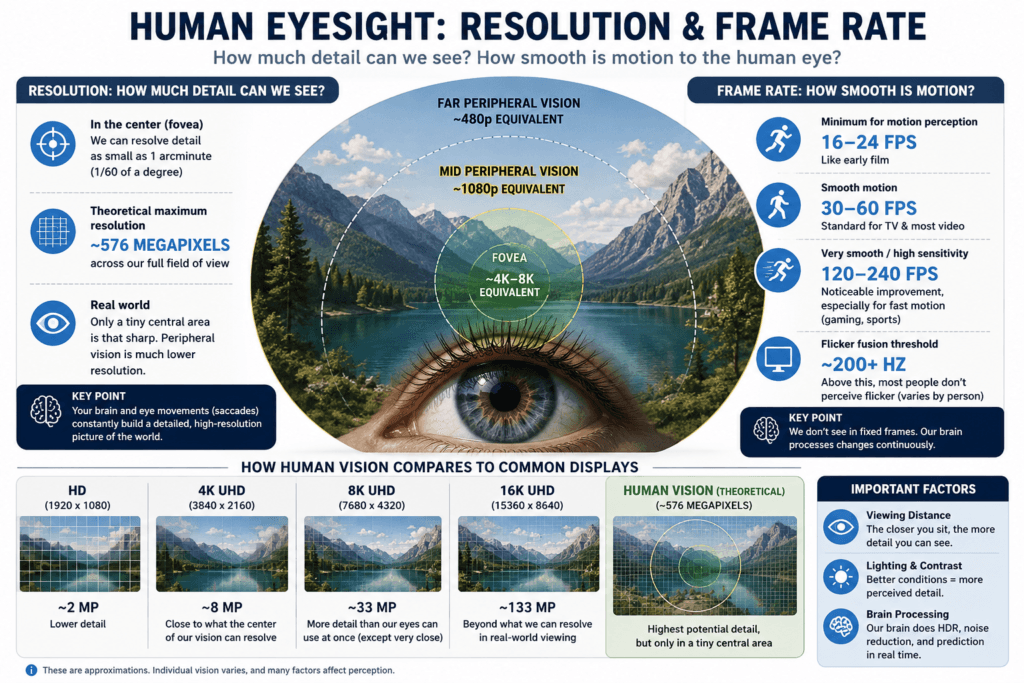
In practical terms, what we actually experience is more like having a very sharp central focus area with blurrier edges. Our brains then combine rapid eye movements and visual processing to create the impression of a fully detailed world around us.
This is why 4K televisions can look incredibly sharp at normal viewing distances, while the benefits of 8K are often harder to notice unless you sit very close to a very large screen. For many people watching from a sofa several metres away, the difference between 4K and 8K may be almost impossible to spot.
Frame rate is another area where human eyesight differs from technology. Unlike a TV or monitor, the eye does not see in fixed frames per second. Instead, the brain continuously processes visual information.
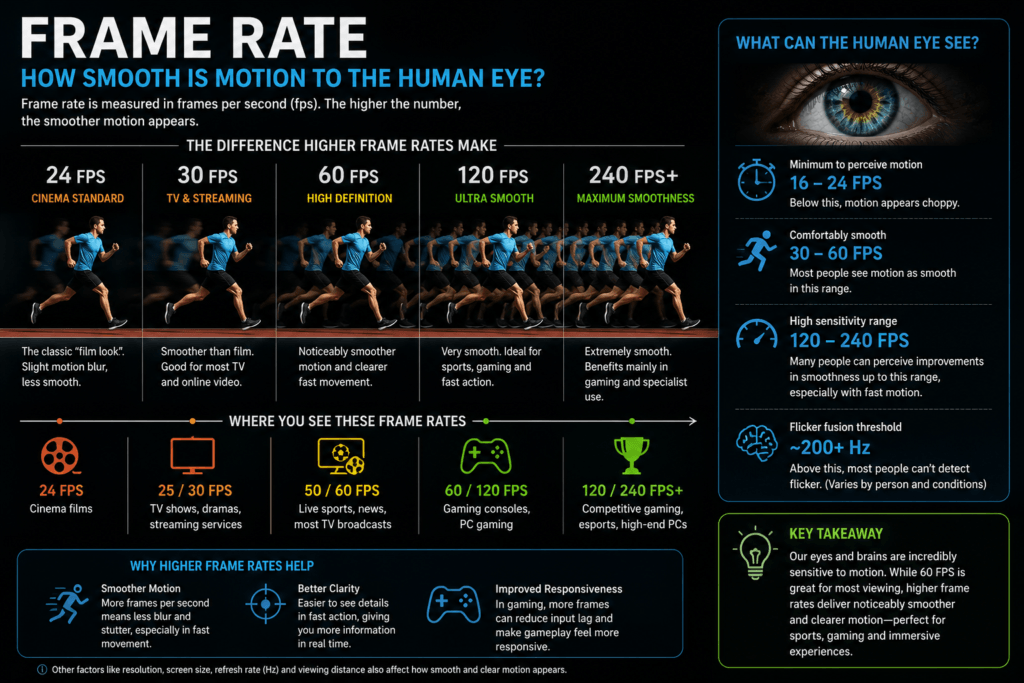
That said, humans can still perceive smoother motion at higher refresh rates. Traditional cinema films run at 24 frames per second, which gives movies their familiar cinematic look. Television broadcasts in Europe often use 50Hz systems, while many sports broadcasts and gaming displays now use 60fps, 120Hz or even higher frame rates.
Higher frame rates are especially noticeable during fast movement. This is why live sport often looks smoother and clearer at higher refresh rates. Fast camera pans, football matches and Formula 1 coverage all benefit from increased motion clarity.
Gamers also frequently notice the difference between 60Hz and 120Hz displays, especially in fast-paced competitive games. A higher refresh rate reduces motion blur and improves responsiveness, making gameplay feel smoother and more immediate.
However, there is a point of diminishing returns. While many people can clearly see the difference between 30fps and 60fps, fewer notice major improvements beyond 120Hz in normal viewing conditions. Human sensitivity to motion varies depending on lighting, movement speed and individual eyesight.
Another factor is motion processing in modern TVs. Many televisions use motion smoothing technology to artificially increase frame rates. Some viewers enjoy the smoother picture, while others dislike the so-called “soap opera effect” that can make films look unnatural.
Ultimately, human eyesight is remarkably sophisticated and still outperforms many cameras and displays in certain areas, particularly dynamic range, colour adaptation and motion interpretation. But modern technology has now reached the point where higher resolutions alone are becoming less important than factors such as contrast, HDR and refresh rates.
For most viewers, a good quality 4K display with strong HDR performance and smooth motion handling will provide a bigger improvement than simply jumping to 8K resolution. The future of television may therefore focus less on extra pixels, and more on delivering a more natural and immersive viewing experience.
Comments
Can the Human Eye Really See in 8K and 120FPS? — No Comments
HTML tags allowed in your comment: <a href="" title=""> <abbr title=""> <acronym title=""> <b> <blockquote cite=""> <cite> <code> <del datetime=""> <em> <i> <q cite=""> <s> <strike> <strong>