
Sky Ireland Targets IPTV Users With Cease-and-Desist Notices
Sky’s long-running battle against illegal IPTV services in Ireland has now taken a major new turn, with the broadcaster directly targeting ordinary subscribers rather than just IPTV resellers and operators. In recent weeks, around 200 Irish households reportedly received cease-and-desist notices accusing them of illegally accessing Sky content through a pirate IPTV service.
The case is attracting huge attention because of how Sky allegedly identified those subscribers. According to reports, customer names and addresses were obtained through payment records supplied by Revolut following a High Court order. For many people following the IPTV world, that development may be even more significant than the legal letters themselves.
The IPTV service at the centre of the case was reportedly operated by David Dunbar, a man from County Wexford who allegedly ran a pirate streaming platform known as “IPTV Is Easy”. The service is said to have offered access to premium sports channels, movies, and subscription television services at a fraction of the normal subscription cost.
Sky had already pursued legal action against Dunbar in the Irish courts before the latest subscriber letters were sent out. Earlier proceedings reportedly resulted in substantial damages and contempt penalties, while also allowing Sky to seek further information about the operation’s customer base.
That is where Revolut entered the picture.
Using what is known as a Norwich Pharmacal Order, Sky reportedly obtained a High Court ruling compelling Revolut to hand over customer information connected to payments made to the IPTV service. Reports suggest Sky received the details of more than 300 subscribers and several resellers linked to the operation.
This part of the case has sent shockwaves through IPTV communities online because it highlights how payment data can become one of the easiest ways to identify users once a provider is compromised. Many IPTV users assume anonymity comes from using unofficial apps or streaming services, but payment trails often tell a very different story.
Part of the cease-and-desist notice sent to subscribers has since been published online, giving a rare insight into the legal approach Sky is now taking against end users.
The document is formally titled:
“Notice of Copyright Infringement and Unlawful Use of IPTV Services”
and reportedly comes directly from Sky’s Legal Litigation and Anti-Piracy Division.
The wording of the letter is noticeably strong. Rather than simply warning recipients, the notice reportedly demands that users immediately stop accessing illegal IPTV services and sign a legally binding undertaking within 14 days.
According to the published PDF, recipients are asked to confirm that they will:
“immediately and permanently disable” access to illegal IPTV services
and:
“never again infringe Sky’s copyright”.
The notice also warns that Sky is:
“fully prepared to take further legal action”
if recipients refuse to comply.
Potential consequences mentioned in the letter reportedly include injunctions, legal costs, damages, and references to possible criminal offences under Irish copyright law. Although the current campaign appears to be focused on civil enforcement rather than criminal prosecution, the language used in the notice clearly appears designed to maximise pressure on recipients.


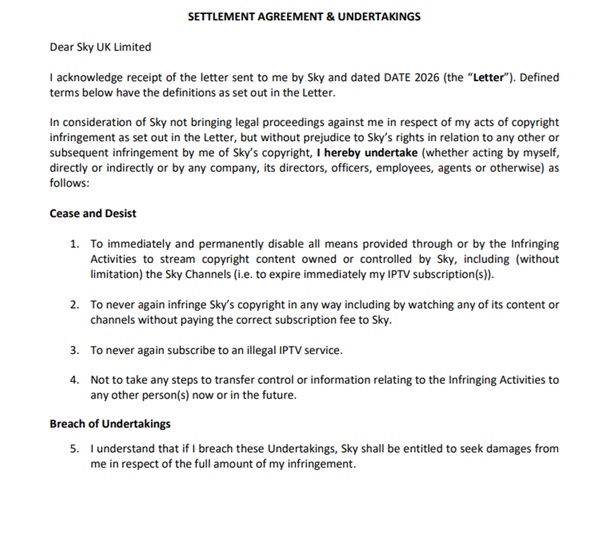
One particularly interesting detail is that Sky reportedly states it will retain the signed undertakings and customer information on record even if no further legal action is taken. That has led to debate online about whether recipients should sign anything at all, with some commenters arguing that signing the document could effectively amount to an admission of past IPTV usage.
At the moment, there is no indication that Sky intends to launch hundreds of individual court cases against subscribers. Many observers believe the broadcaster’s main objective is deterrence. By sending legal notices directly to end users and ensuring the story receives widespread media coverage, Sky may hope to create enough fear and uncertainty to discourage others from using pirate IPTV services in future.
Even so, the possibility of a handful of “test cases” cannot be ruled out. If Sky successfully pursued a small number of subscribers through the courts, it could significantly strengthen the deterrent effect of future anti-piracy campaigns.
The wider implications of the case are likely to be felt well beyond Ireland. Across Europe, broadcasters and rights holders are becoming increasingly aggressive in their efforts to combat IPTV piracy, particularly around live sports. With billions invested in football, Formula 1, boxing, and other premium content, broadcasters are under growing pressure to reduce illegal streaming.
For many people following the case, the biggest takeaway is not the legal wording of the cease-and-desist letters, but the fact that subscriber identities were allegedly uncovered through financial records. The Irish crackdown demonstrates that once IPTV providers fall under legal scrutiny, payment platforms such as Revolut may become one of the most powerful tools available to anti-piracy investigators.
Comments
Sky Ireland Targets IPTV Users With Cease-and-Desist Notices — No Comments
HTML tags allowed in your comment: <a href="" title=""> <abbr title=""> <acronym title=""> <b> <blockquote cite=""> <cite> <code> <del datetime=""> <em> <i> <q cite=""> <s> <strike> <strong>