
Geostationary vs Low Earth Orbit Satellites
When most people think of satellites, they imagine a single spacecraft floating high above the Earth, providing television, internet or communications. In reality, there are several different types of satellite orbits, each designed for specific purposes. The two most common for communications are Geostationary Earth Orbit (GEO) and Low Earth Orbit (LEO).
Although both are used to transmit data around the world, they operate in very different ways. Traditional satellite television services such as Sky and Freesat rely on geostationary satellites, while modern broadband providers like Starlink use thousands of Low Earth Orbit satellites.
What is a Geostationary Satellite?
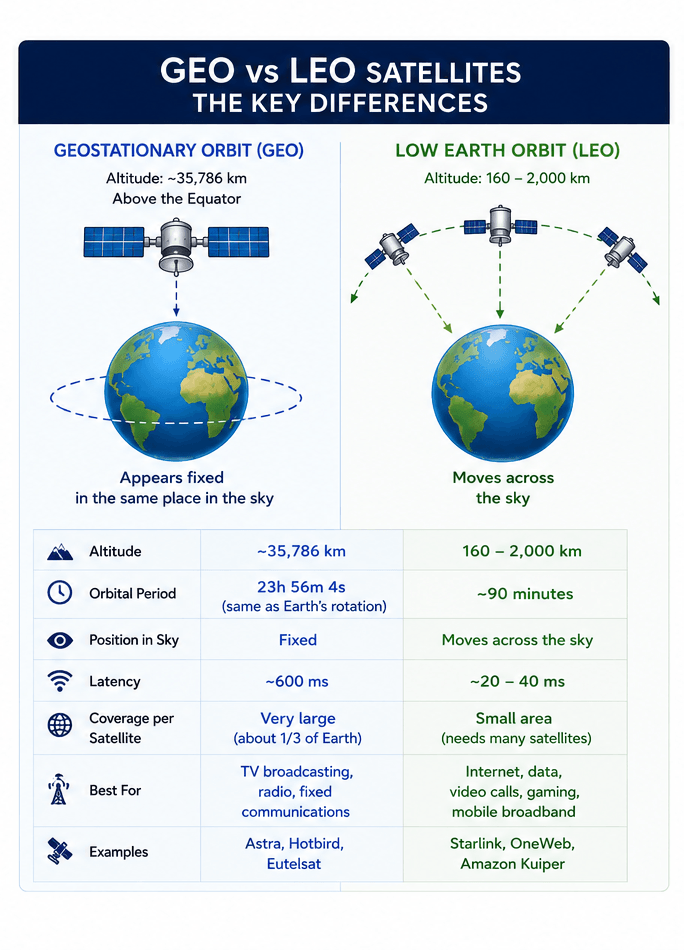
A geostationary satellite orbits approximately 35,786 km (22,236 miles) above the Earth’s equator.
At this altitude it takes exactly the same amount of time to orbit the Earth as the Earth takes to rotate once on its axis—23 hours, 56 minutes and 4 seconds. Because the satellite matches the Earth’s rotation, it appears to remain fixed in one position in the sky.
This is why your satellite dish never has to move. Once it has been aligned towards satellites such as Astra 28.2° East, it can remain pointing in the same direction for years.
A single geostationary satellite can see around one-third of the Earth’s surface, making it ideal for broadcasting television and radio services to millions of homes simultaneously.
What is a Low Earth Orbit Satellite?
Low Earth Orbit (LEO) satellites operate much closer to the Earth, typically between 160 km and 2,000 km above the surface.
Because they are much closer, they travel around the Earth far more quickly, completing an orbit in around 90 minutes. Unlike geostationary satellites, they do not stay fixed over one location. Instead, they constantly move across the sky.
If you were to watch a LEO satellite pass overhead, it would appear to rise above the horizon, travel across the sky, and disappear again within a few minutes.
Since each satellite only covers a relatively small area of the Earth, hundreds or even thousands of satellites are required to provide continuous worldwide coverage.
The Main Differences
The biggest differences between GEO and LEO satellites are their altitude, coverage and signal delay.
Geostationary (GEO) satellites:
- Orbit at 35,786 km above Earth.
- Appear fixed in one position.
- One satellite covers a huge area.
- Ideal for television broadcasting.
- Higher signal delay (latency).
Low Earth Orbit (LEO) satellites:
- Orbit between 160 and 2,000 km.
- Move continuously across the sky.
- Each satellite covers a much smaller area.
- Thousands are needed for global coverage.
- Much lower latency, making them ideal for internet services.
Why Does Starlink Use LEO?
One of the biggest disadvantages of geostationary satellites is latency.
Every signal has to travel from your home to the satellite, then back down to a ground station, and often return the same way. Since the satellite is almost 36,000 kilometres above the Earth, this creates a noticeable delay—typically around 600 milliseconds for a round trip.
That isn’t a problem for watching television, as broadcasts are one-way and a slight delay makes no difference.
Internet connections are different.
Activities such as video calls, online gaming, cloud applications and video conferencing require data to travel backwards and forwards almost instantly. High latency makes these services feel sluggish.
Because Starlink satellites orbit only a few hundred kilometres above the Earth, signals travel a much shorter distance. Typical latency is between 20 and 40 milliseconds, giving a much more responsive internet connection.
The trade-off is that Starlink cannot rely on just a handful of satellites. Instead, it operates a constellation of thousands of LEO satellites that work together. As one satellite moves out of view, your Starlink dish automatically switches to the next one without interrupting your connection.
Which Orbit is Better?
Neither orbit is “better”—they are simply designed for different purposes.
For broadcasting television and radio, geostationary satellites remain the perfect solution. They provide enormous coverage with relatively few satellites, allowing fixed dishes to receive signals reliably for many years.
For modern broadband internet, Low Earth Orbit satellites offer much lower latency and faster response times, making them ideal for interactive applications where every millisecond counts.
The Future of Satellite Communications
Rather than replacing each other, GEO and LEO satellites are likely to continue working side by side.
Geostationary satellites will remain the backbone of television broadcasting, weather monitoring and many commercial communications, while LEO constellations such as Starlink, OneWeb and Amazon’s Project Kuiper continue to expand high-speed internet access around the world.
Together, these two technologies ensure that whether you’re watching satellite TV, making a video call, or browsing the web from a remote location, there is a satellite system designed to deliver the service efficiently.
Comments
Geostationary vs Low Earth Orbit Satellites — No Comments
HTML tags allowed in your comment: <a href="" title=""> <abbr title=""> <acronym title=""> <b> <blockquote cite=""> <cite> <code> <del datetime=""> <em> <i> <q cite=""> <s> <strike> <strong>